Step 1: Stop the Source (0 to 5 Minutes)
- Shut the local supply valve. For dishwashers, the valve is under the sink. For washing machines, behind the unit (hot and cold).
- If you cannot isolate locally, close the main shutoff. In most Cicero homes this is in the basement near the front foundation wall or in a utility closet.
- Kill power to the affected circuit at the breaker panel. Do not stand in standing water to reach a panel.
- Photograph the source, the valve position, and the surrounding area from four angles before touching anything else.
- If the source is a supply line failure, cap the line with a SharkBite or compression cap before reopening any upstream valves.
Step 2: PPE and Safe Entry (5 to 10 Minutes)
- Nitrile gloves, minimum 5 mil thickness.
- Rubber boots or shoe covers rated for liquid contact.
- N95 respirator if the water has been sitting more than 12 hours.
- Safety glasses if overhead drywall is sagging or dripping.
- Do not let children or pets enter the affected zone until extraction is complete.
- Tyvek coveralls if you will be cutting or removing wet drywall, since the inner face often holds higher bacterial counts than the surface water.
Step 6: Structural Drying Setup (Hours 4 to 8)
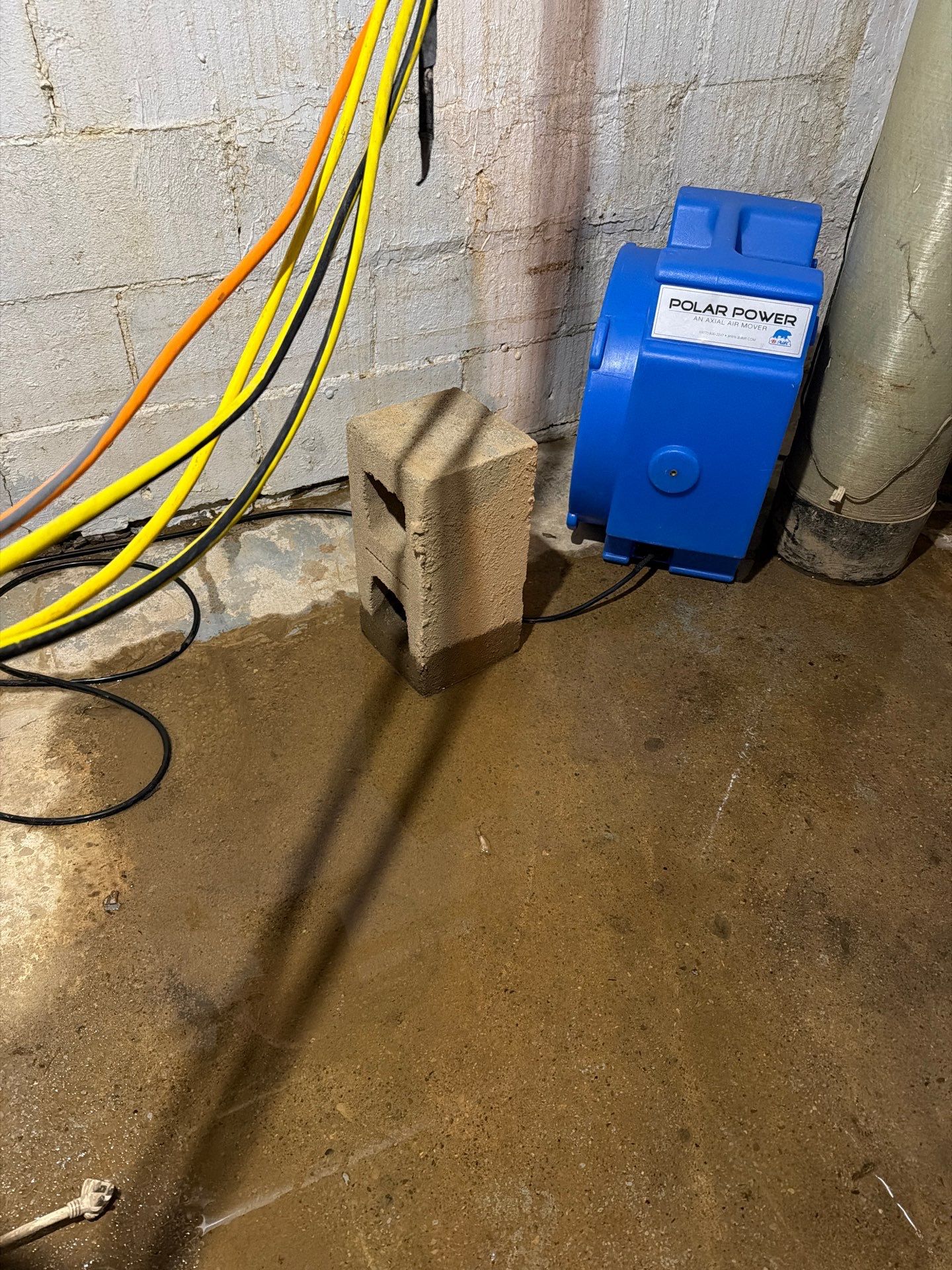
- One air mover per 50 to 60 square feet of affected wall and floor surface, angled at 15 to 45 degrees.
- One LGR dehumidifier per 1,000 to 1,500 cubic feet of affected space. Low Grain Refrigerant units pull 12 to 30 gallons per day in Cicero's humidity range.
- Target ambient: 70 to 90 degrees F, relative humidity under 40%, specific humidity under 55 grains per pound.
- If subfloor or wall cavity moisture exceeds 20%, drill weep holes or remove baseboards to vent the cavity.
- Affected hardwood gets mat drying systems with negative-pressure manifolds. Detailed protocols for floor salvage decisions are covered in our hardwood floor water damage guide.
- Contain the drying chamber with 6 mil poly walls when adjacent unaffected rooms are climate controlled. Containment reduces dehumidifier load by 30 to 50%.
Step 9: Final Clearance and Documentation
- Final moisture map showing all readings at or below dry standard.
- Before, during, and after photos for every affected room.
- Equipment log: serial numbers, run hours, daily readings.
- Itemized invoice mapped to Xactimate line items for your adjuster. See our complete price breakdown for typical line-item ranges.
- Antimicrobial product SDS sheets included in the file.
- Certificate of completion signed by the lead technician and the homeowner, with a notation that the structure meets the S500 dry standard.
Step 3: Categorize and Document (10 to 30 Minutes)
- Confirm Category 2 classification by source. Grey water sources include appliance discharge, shower runoff, and clean toilet overflows.
- If the water passed through ceiling insulation, sat over 48 hours, or contacted any sewage line, reclassify as Category 3 and call professional sewage cleanup immediately.
- Measure affected square footage. Note flooring type, wall type, and whether water migrated under cabinets or baseboards.
- Record water depth at the deepest point. Photograph a ruler in the water.
- Start a contents inventory: anything porous touched by grey water (upholstery, mattresses, paper, particleboard) is generally non-salvageable under S500.
- Note Class designation as well. Class 1 affects part of a room with minimal absorption, Class 2 saturates an entire room and wicks up walls under 24 inches, Class 3 involves overhead saturation, and Class 4 includes deeply held materials like hardwood, plaster, and masonry.
Step 7: Daily Monitoring (Days 1 to 4)
- Moisture readings logged every 24 hours on a drying chamber map.
- Targets: framing lumber under 16%, drywall under 1% on a pinless meter, concrete under 4%.
- Equipment is repositioned, added, or removed based on readings, not on a fixed schedule.
- Most Category 2 losses in Cicero reach dry standard within 3 to 5 days.
- Record temperature, RH, and GPP at three points: inside the chamber, outside the chamber, and at the dehumidifier exhaust. A working LGR should exhaust 15 to 20 degrees F warmer than ambient.
Typical Cicero Pricing Ranges
- Small Category 2 loss (one room, under 200 sq ft): $1,500 to $3,500.
- Mid-size loss (multiple rooms, 200 to 600 sq ft): $3,500 to $8,000.
- Large loss with demolition (over 600 sq ft or multiple floors): $8,000 to $18,000.
- Most homeowner policies cover sudden-discharge grey water events. Gradual leaks (over 14 days) are commonly excluded.
- Cicero Water Restoration bills direct to most major carriers and provides Xactimate-compatible documentation with every file.
Step 10: Post-Mitigation Verification
- Schedule a 30-day follow-up inspection to confirm no secondary microbial growth has developed inside repaired wall cavities.
- Use a borescope through a small inspection hole at the base plate if any odor returns.
- Verify HVAC operation. Run the system for 15 minutes and check supply registers for musty odor or particulate discharge.
- Confirm reconstruction does not begin until written clearance is issued. Closing walls over damp framing is the most common cause of mold claims six to twelve months after a loss.
Step 5: Antimicrobial Application (Same Day as Extraction)
- EPA-registered antimicrobial applied to all affected surfaces at label dilution.
- Dwell time: minimum 10 minutes before drying equipment runs.
- Wall cavities are treated through small inspection holes drilled at the base plate, 12 to 16 inches on center.
- HVAC supply and return registers in the affected zone are sealed with 6 mil poly until duct inspection is complete.
- Cicero Water Restoration technicians log product name, EPA registration number, dilution ratio, and square footage treated on the job file.
Step 4: Extraction (30 Minutes to 4 Hours)
- Truck-mounted or portable extractors pull standing water at rates of 8 to 25 gallons per minute depending on equipment.
- Target: zero standing water and surface moisture content under 16% on wood, under 1% on concrete before drying equipment is staged.
- Carpet over Category 2 water is typically removed. Pad is always removed. The S500 standard allows carpet to be cleaned and reinstalled only if it is structurally sound and decontaminated within 24 hours.
- Sub-floor wood is extracted with weighted wand attachments to pull water from the seams.
- Document extracted volume. A 200 square foot loss with one inch of standing water yields roughly 125 gallons.
- For multi-room losses, extract from the perimeter inward to prevent pushing water into previously dry areas.
Step 8: Demolition Decisions
- Drywall: cut 12 to 24 inches above the waterline if cavity insulation is wet. Flood cuts are documented and photographed before removal.
- Insulation: fiberglass batts that wicked grey water are removed and bagged.
- Cabinets: kick plates removed for inspection. Particleboard bases that swelled past 2% expansion are replaced.
- Baseboards and shoe molding are pulled before drying to vent wall cavities.
- Engineered flooring with delamination at the seams is removed. Solid hardwood with cupping under 1/8 inch over 6 inches can often be sanded and refinished after drying.